On this page
- BC water temperature reality
- BC’s seasonal pattern
- Quick picks
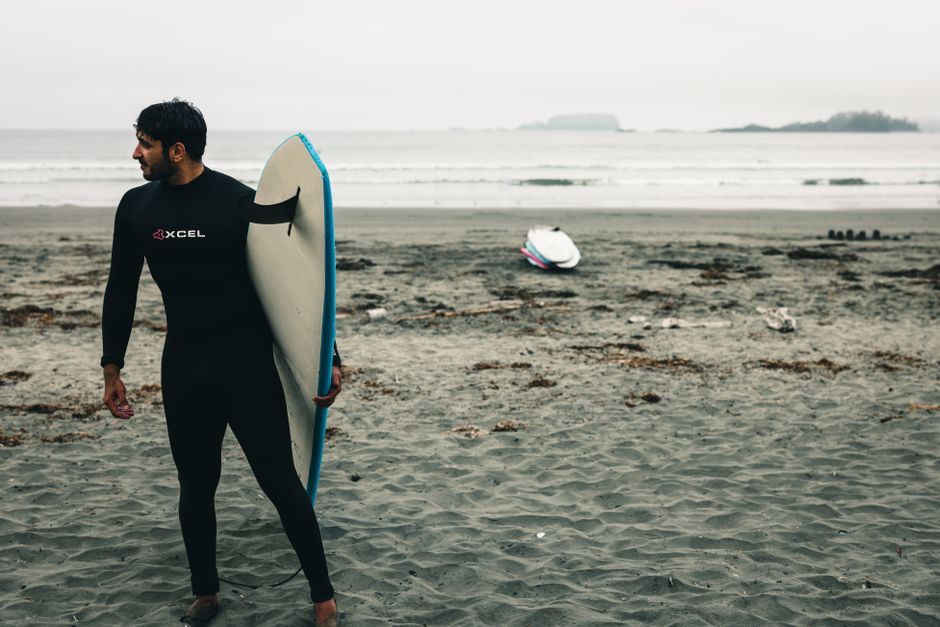
- Best overall BC year-round: Xcel Drylock 5/4 Hooded
- Best storm-watching season: O’Neill Psycho Tech 5/4 Hooded
- Best fast-dry for trips: Rip Curl Flashbomb Heatseeker 5/3 Hooded
- Best 4/3 hooded for shoulder: O’Neill Mutant 4/3
- Best budget BC: Need Essentials 5/4 Hooded
- Spot-specific notes
- Cold-water accessories for BC
- How we tested
- Putting it together
- Sources cited
British Columbia’s west coast is where cold-water surf culture in North America matures fastest. The water at Tofino and Long Beach sits in the same band as the Oregon coast (47 to 58°F across the year), but the swells are bigger, the storms are more frequent, and the storm-watching surf community has built a year-round identity around it. We have surfed Tofino’s beaches and the gear notes here come from those sessions. For the rest of British Columbia, we have less firsthand context and say so where it matters.
For broader cold-water context, our Pacific Northwest pillar covers the seasonal pattern and gear philosophy that applies across the entire West Coast. This article narrows to British Columbia specifically.
Key Takeaways
- • BC coastal water at Tofino sits between roughly 47 and 58°F across the year, similar to the Oregon coast.
- • A 5/4 hooded handles winter; 4/3 hooded covers shoulder months.
- • Storm-watching season (Nov to Feb) is the BC peak window; surf is bigger and crowds smaller in winter.
- • Long Beach is exposed; Cox Bay and Chesterman are slightly more sheltered. Wind exposure varies more than water temperature here.
BC water temperature reality
The British Columbia Shore Station Oceanographic Program (BCSOP), operated by Fisheries and Oceans Canada, has collected daily sea-surface temperature observations at Amphitrite Point lightstation near Ucluelet (just south of Tofino) since the 1930s. The published 1991 to 2020 climatology covers the modern reference period.
Specific monthly mean values from the BCSOP archive are not available as a single extracted table the way NDBC climatic summaries are. The qualitative pattern from the published BCSOP records and adjacent NDBC data:
- Coldest months: February and March, with mean SST in the 46 to 48°F band.
- Warmest months: August and September, with mean SST in the 54 to 58°F band.
- Annual range: Roughly 10°F, similar to Oregon’s coast.
- Seasonal pattern: Coldest in late winter, warmest in late summer (same upwelling-driven inversion as the rest of the West Coast).
For verifiable data access, the BC Shore Station SST dataset is published through Open Government Canada (dataset 719955f2-bf8e-44f7-bc26-6bd623e82884) and through the BC Lightstation SST visualization site (ios-osd-dpg.github.io/bc_lightstation_sst). The full archive is available as CSV downloads.
For more on how thickness maps to water temperature, see our thickness guide and the interactive temperature chart.
BC’s seasonal pattern
The BC year, in wetsuit terms (Tofino-centric):
- August through early October is the warmest window. Water in the mid-50s°F to upper-50s°F, often the cleanest conditions of the year. 4/3 with separate hood by default; some surfers wear 4/3 hooded for the wind. Genuine 3/2 weather rarely happens.
- October through November is shoulder transition. Storms ramp up, water cools toward 50°F. We default to 4/3 hooded.
- December through March is winter / storm-watching season. Water in the 47 to 50°F band, swells are bigger, storms more frequent, crowds smaller. 5/4 hooded is the primary suit.
- April through May is the cooler back-half. Water still in the high 40s°F to low 50s°F. 5/4 hooded continues; some surfers transition to 4/3 hooded by mid-May.
- June through July is shoulder-cool. Water 50 to 54°F. 4/3 hooded for most surfers, 4/3 with separate hood for warm pulses.
This is fundamentally similar to Oregon’s pattern, just shifted a degree or two cooler and with a heavier storm-watching identity.
Quick picks
| Category | Pick | Price |
|---|---|---|
| Best overall BC year-round | Xcel Drylock 5/4 Hooded | $500–$600 |
| Best storm-watching season | O’Neill Psycho Tech 5/4 Hooded | $550–$650 |
| Best fast-dry for trips | Rip Curl Flashbomb Heatseeker 5/3 Hooded | $500–$600 |
| Best 4/3 hooded for shoulder | O’Neill Mutant 4/3 (detachable hood) | $300–$400 |
| Best budget BC | Need Essentials 5/4 Hooded | $230–$280 |
Best overall BC year-round: Xcel Drylock 5/4 Hooded
We have worn the Drylock 5/4 hooded in multiple Tofino sessions across late winter and shoulder months. The fully taped seams hold against the cold flush of duck-diving in 47°F water. The DrylockCelliant lining recovers warmth fast, which matters at Long Beach where the wind is on you the moment you stand up. The hood pattern works well for most head shapes; we have not had hood fit problems with it.
The trade-offs are slim chest sizing, slow overnight drying, and premium pricing. None of those are dealbreakers for a year-round BC suit, but they are real.
Best storm-watching season: O’Neill Psycho Tech 5/4 Hooded
For genuinely cold winter sessions in 47 to 49°F water, single-session warmth retention is the dominant variable. The Psycho Tech’s Firewall Pro thermal lining is the warmest single-session lining we have tested. We have worn it on storm-watching weekends at Long Beach where the water was reading 48°F and finished a 75-minute session warm.
Slightly stiffer through the shoulders than the Drylock; slower overnight drying. For storm-watching trips where you might surf Saturday afternoon and not Sunday morning, this trade is fine.
Best fast-dry for trips: Rip Curl Flashbomb Heatseeker 5/3 Hooded
Tofino is a destination for many cold-water surfers; fly in for a long weekend, surf two or three days in a row, fly out. The Flashbomb Heatseeker’s Flash Lining handles back-to-back use better than any other suit in this guide. Hang it overnight in the rental cabin and it is wearable by morning where a comparable non-Flash suit would still be cold and damp.
Slightly cooler per single session than Drylock or Psycho Tech, but the difference shows up at the end of a 90-minute session, not in the first hour.
Best 4/3 hooded for shoulder: O’Neill Mutant 4/3
For BC surfers who only own one wetsuit and want flexibility across the year, the Mutant’s detachable hood approach is the answer. Hood off for August at Cox Bay, hood on for November storms at Long Beach. We have used it as a one-suit BC kit in years when the deep-winter weeks happened to fall outside our travel windows.
The seal at the hood-to-collar transition is not as tight as a fully integrated hooded suit. For BC’s shoulder months that does not matter; for February it does.
Best budget BC: Need Essentials 5/4 Hooded
For surfers building a BC kit on a budget, the Need Essentials 5/4 hooded is the only sub-$300 option that holds up in genuine cold water. GBS construction with inside taping, integrated hood, basic thermal lining. Less warmth than premium suits, but the construction is real and it will keep you in the water.
Spot-specific notes
We have surfed Long Beach and the surrounding Tofino-area beaches. The notes below come from those sessions.
Long Beach (Pacific Rim National Park). Twelve miles of sand beach inside Pacific Rim National Park Reserve. Highly exposed; wind picks up fast. The most consistent break in the Tofino area; also the most crowded on weekends. Through winter, we have worn 5/4 hooded as default. Late summer pulses can be 4/3 hooded weather. Pack a windbreaker for the post-session walk back to the car; you will be cold before you change.
Cox Bay. South of Long Beach proper, surrounded by older-growth forest, slightly more sheltered. Generally easier on cold-water novices because the wind is less brutal on the paddle out. We default to the same suits as Long Beach.
Chesterman Beach (North and South). Closer to Tofino town, sheltered from some wind directions, family-friendly access. Same gear answer as Long Beach.
Pacific Rim’s outer beaches (Schooner Cove, etc.). Less accessed; wave quality varies. We have not surfed these enough to characterize them specifically. The gear answer is the same as the rest of Long Beach.
For surfers continuing south down Vancouver Island toward Sombrio Beach, Jordan River, or the Sooke Potholes area, those are spots we have less direct experience with. Treat the gear answer as transferring from Tofino with one adjustment: the Strait of Juan de Fuca’s exposure on the south coast can run a degree or two colder than Tofino itself. The published BC Shore Station data from Race Rocks and other south-coast sites supports this.
For broader regional context, see our Pacific Northwest pillar and adjacent Washington coast guide.
Cold-water accessories for BC
Below 50°F water (most of the year in winter and shoulder months), accessories matter.
Boots. 5mm round-toe handles most of the year; 7mm for storm-watching weeks. O'Neill Heat 5mm for shoulder; Xcel Drylock 7mm for the deep months.
Gloves. 5mm five-finger handles most of winter for most surfers. Rip Curl Flashbomb 5mm glove . Mittens for the coldest sessions: O'Neill Psycho Tech 7mm mitten .
Hood. A 3mm hood is the highest-leverage shoulder-month accessory. Xcel Drylock 3mm hood seals well under most surf-suit collars.
For broader accessory picks, see best cold-water wetsuits.
How we tested
These suits have been worn by team members across Tofino-area beaches in multiple shoulder-season and winter sessions. We log session length, water temperature (cross-referenced with Amphitrite Point lightstation data when available), wind, and subjective comfort at 30, 60, and 90 minutes. For BC specifically, we have less long-term durability data than for Oregon or Washington because we surf BC less often. The picks here reflect our hands-on experience plus the recommendations of regular Tofino surfers we have spent time with.
For Vancouver Island spots beyond Tofino, treat our characterizations as compiled from research rather than firsthand. We bought our suits at retail; none were provided by brands. Our methodology page covers our testing process.
Putting it together
The cleanest BC setup is a 5/4 hooded primary (Drylock, Psycho Tech, or Flashbomb Heatseeker) with an optional 4/3 hooded backup (Mutant) for shoulder months. Add 5mm and 7mm boots, 5mm gloves with mittens for the coldest weeks, and a separate 3mm hood if you ever surf the warmer shoulder months in a 4/3 non-hooded setup.
For broader cold-water context across the West Coast, see the PNW pillar, Oregon coast guide, Washington coast guide, and Northern California guide. For a BC multi-suit setup mapped in one pass, the Quiver Builder tool covers the 5/4 hooded primary plus 4/3 hooded backup plus accessories.
Sources cited
- BC Shore Station Oceanographic Program (Amphitrite Point lightstation), 1991–2020 climatology. Fisheries and Oceans Canada. open.canada.ca dataset 719955f2-bf8e-44f7-bc26-6bd623e82884
- BC Lightstation Sea-Surface Temperature visualization. ios-osd-dpg.github.io/bc_lightstation_sst/
- NDBC Station 46050 (Stonewall Bank, OR) climatic summary as comparison reference. ndbc.noaa.gov/data/climatic/46050.txt
Frequently asked
Is Tofino water colder than Oregon water?
Marginally, with similar seasonal patterns. The BC Shore Station Oceanographic Program records at Amphitrite Point lightstation (just south of Tofino at Ucluelet) have been collected since the 1930s and show a 1991 to 2020 climatology pattern very similar to NDBC 46050 (Stonewall Bank, OR), with peak summer water in the mid-50s°F and winter lows in the high 40s°F. Tofino runs a degree or two cooler than central Oregon on average.
Is BC surfing only viable in winter?
Storm-watching season (November through February) gets the most attention because the swells are the largest and most consistent. But Tofino is a year-round surf destination. Late summer and early fall (August through October) often have cleaner conditions with smaller, more rideable surf. The water in late summer is the warmest of the year and approaches 56 to 58°F.
What thickness for Tofino in winter?
5/4 hooded is the right primary suit from December through March. Many regulars run a 5/4 hooded year-round in BC because the summer warm-water window is short and the wind picks up fast. For storm-watching season specifically, plan for a 5/4 hooded with 7mm boots and 5 to 7mm gloves or mittens. A 4/3 hooded works for September and early October sessions; not for the deep months.
Can I surf BC year-round in one wetsuit?
If you want to. A 5/4 hooded is overkill for late August but it works. The simpler answer is a single 5/4 hooded plus a 3mm shorty top for layering in the rare warm pulse. Most BC regulars we know own a 5/4 hooded primary suit and either skip the warm-water surfing or wear a 4/3 hooded for it.
About The WetsuitCenter Team
Our buying guides are written and maintained by staff who actually get cold and wet testing this gear: surfers, divers, and open-water swimmers logging real hours across seasons and water temps.
You might also like
Best Wetsuits for the Oregon Coast
Oregon-specific wetsuit picks anchored to NDBC buoy data and firsthand sessions at Pacific City, Short Sands, Indian Beach, Cannon Beach, and Seaside.
Best Wetsuits for Pacific Northwest Surfing
PNW-specific wetsuit picks for surfers in Oregon, Washington, and the Salish Sea, anchored to NOAA buoy data and tested in actual cold water.
Best Surfing Wetsuits (2026 Buyer's Guide)
Independent picks for the best surfing wetsuits across price tiers. Cold-water hooded suits, all-rounder 3/2mm, budget-friendly options, and a warm-water spring suit.