On this page
- What the two numbers mean
- Why thickness varies across the suit
- The thickness ladder, in plain English
- 1mm / Dive skin / Rashguard
- 2mm (shorty or full suit)
- 3/2mm (standard full suit)
- 4/3mm (cold-water full suit)
- 5/4mm or 5/4/3mm (cold-water hooded)
- 6/5mm and 6/5/4mm
- 7mm and drysuit territory
- How thickness affects flexibility
- How thickness affects warmth
- How thickness affects buoyancy
- The 3-number suits: what changes with 5/4/3
- Quick reference table
- How to pick
If you’ve ever looked at a wetsuit spec sheet and wondered what 3/2mm actually means. Or why some suits are labeled 4/3mm while others are simply 4mm. This guide is for you. The numbers follow a specific logic, and understanding it makes choosing the right suit much easier.
Key Takeaways
- • The first number is torso thickness, the second is limb thickness. 3/2mm means 3mm torso, 2mm arms and legs.
- • Thicker = warmer and stiffer and more buoyant. Every increase in mm is a tradeoff.
- • Modern suits strategically vary thickness by panel. Thick where you need warmth, thin where you need flex.
- • For most users, 3/2mm is the best all-around choice. 4/3mm for cold water. 5/4mm or thicker for genuinely cold water with a hood.
What the two numbers mean
Wetsuit thickness labels are written as torso/limb in millimeters. A 3/2mm suit has:
- 3mm of neoprene across the torso (chest, back, seat)
- 2mm of neoprene on the arms and legs
A 4/3mm suit has a 4mm torso and 3mm limbs. A 5/4mm has a 5mm torso and 4mm limbs. And so on.
Some older or budget-tier suits are labeled with a single number (e.g., 3mm): in that case, the whole suit is uniform thickness.
You’ll also see suits like 5/4/3mm or 6/5/4mm. The third number is the thickness of the most mobile panels. Typically the shoulders. On a 5/4/3mm, the torso is 5mm, the legs and most of the arms are 4mm, and the shoulder flex zones are thinned to 3mm to help paddling. This is strategic layering: warmth where you need it, flexibility where you need it.
Why thickness varies across the suit
Imagine wearing a 4mm layer of closed-cell foam around your entire body. You’d be very warm. And you’d also move like a Michelin mascot. Every reach, bend, and squat would fight you.
The core insight of modern wetsuit design is that you don’t need uniform warmth. Your torso contains the organs that care most about staying warm. Your arms and legs are moving constantly. Muscle activity generates heat, blood circulates through them regardless, and you need them to stay mobile.
So manufacturers put thicker, warmer neoprene where it matters (core) and thinner, stretchier neoprene where movement matters (limbs, especially shoulders and knees). The result: more warmth for the same flex, or more flex for the same warmth.
This is why a premium 3/2mm can feel warmer than a budget uniform 3mm. It’s not just the thickness. It’s the placement.
For more on how this connects to the overall buying decision, see our complete guide to choosing a wetsuit.
The thickness ladder, in plain English
Each thickness step corresponds roughly to a water temperature band. Here’s what each common thickness is good for:
1mm / Dive skin / Rashguard
Not really a wetsuit. More of a base layer. Used in tropical water for sun protection, light insulation, or as an underlayer beneath a thicker suit in cold water. Essentially no warmth on its own; it’s about UV, abrasion, or jellyfish protection.
2mm (shorty or full suit)
The lightest “real” wetsuit territory. Works for water 72–78°F and for active short sessions in water as cool as 68°F. Shorties (arms and legs cut short) are popular for snorkeling, paddling, and tropical surf trips. A 2mm full suit is a nice weight for mild water in summer.
3/2mm (standard full suit)
The workhorse. Good for 62–70°F water for most people, most of the time. This is the single most popular thickness sold in surf shops. If you’re buying a “general” wetsuit without a specific cold-water use case, start here. Enough flex to paddle comfortably, enough warmth to stay in the water for an hour-plus.
4/3mm (cold-water full suit)
Steps into serious cold-water territory. Good for 55–62°F water for most people. You’ll notice the extra thickness in the shoulders. The suit feels slightly more substantial on. Below 58°F, plan on booties with the 4/3, especially for longer sessions.
5/4mm or 5/4/3mm (cold-water hooded)
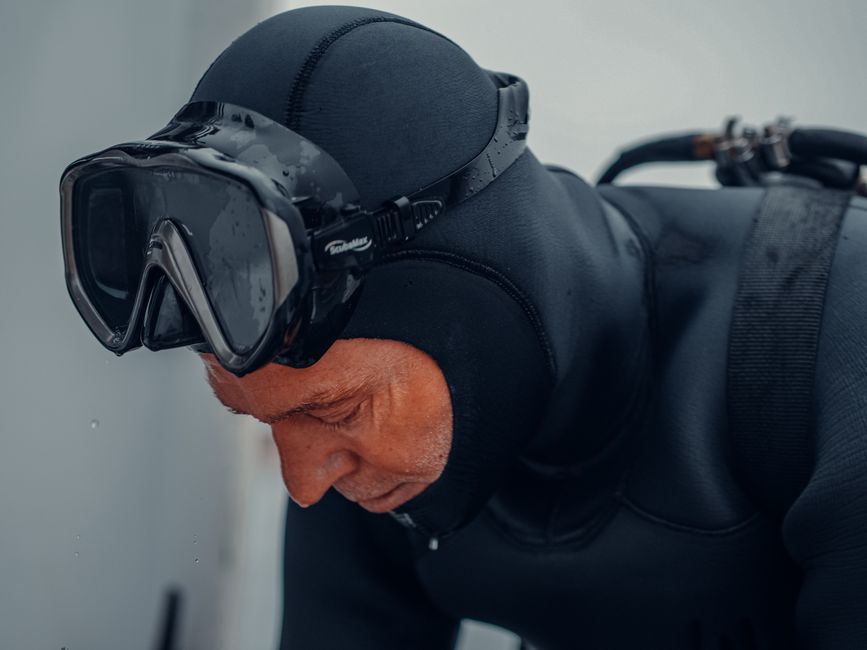
Winter territory in most temperate regions. Good for 48–56°F. At this thickness, suits typically come with an attached or separate hood, because heat loss from the head becomes a serious factor. Boots and gloves are near-mandatory below 52°F.
6/5mm and 6/5/4mm
Heavy-duty cold-water suits. Water 42–50°F. You feel the thickness when walking around. These are not suits you buy for casual use. Used in places like Oregon winter, Scotland, Nova Scotia, and the Great Lakes. Always hooded. Plan on 7mm boots and 5mm gloves as minimum accessories.
7mm and drysuit territory
Below 42°F water, most people should be in a drysuit rather than a wetsuit. Drysuits use a waterproof shell over insulating undergarments, letting you stay dramatically warmer for longer. Serious cold-water freedivers still use 7mm two-piece open-cell wetsuits, but for surfing or general water sports, the drysuit crossover happens somewhere around 42–45°F.
For the full water-temperature-to-thickness table with regional examples, see our temperature guide. Or use our interactive temperature chart to drag the slider to your actual water temp.
How thickness affects flexibility
Neoprene is foam rubber. The more foam you stack, the stiffer the stack gets. This is why thicker suits feel less flexible. It’s physics, not bad design.
A 3/2mm full suit feels almost like a second skin once you’re in the water. Paddling is natural, shoulder mobility is strong, duck-diving is unrestricted.
A 4/3mm full suit feels noticeably more substantial. Paddling takes slightly more effort at first, though you adapt quickly. Most people don’t notice the thickness once they’re warm and in rhythm.
A 5/4mm hooded suit is a different experience. Shoulders have clear limits. You plan your movements more deliberately. Duck-diving a surfboard takes extra push. Most cold-water surfers adapt, but the stiffness is always there.
Premium suits use their most flexible neoprene in the shoulders specifically to counteract this. On a top-tier 5/4mm, the shoulder panels might actually be 3mm of ultra-stretchy foam. Giving you the flex of a 3mm where you need it most while the torso stays 5mm.
How thickness affects warmth
Each additional millimeter adds warmth, but not linearly. The gain from 2mm to 3mm is larger than the gain from 5mm to 6mm, because wetsuit warmth is ultimately about trapping a thin layer of water against your skin that your body then heats to a comfortable temperature. Past a certain point, adding material has diminishing returns.
More important than raw thickness for warmth:
- Seam construction. Flatlock seams leak. Taped seams don’t. A 3/2mm with taped seams can out-warm a 4/3mm with flatlock seams. Our seams guide covers this in detail.
- Fit. A loose 4/3 lets water flush through constantly. That flushing is what actually makes you cold. A snug 3/2 beats a baggy 4/3 every time.
- Lining. Thermal plush linings trap a warm air layer against your skin. Suits without it warm up much more slowly after a flush.
- Entry system. A chest-zip holds out more water than a back-zip during duck-dives and descents.
This is why thickness alone is a bad purchase criterion. A cheap 5/4mm with flatlock seams and a loose fit can be colder than a premium 3/2mm with sealed seams and a proper fit.
How thickness affects buoyancy
This is the forgotten variable. Neoprene floats. Thicker neoprene floats more.
A 3/2mm surfing suit adds a modest amount of buoyancy. Helpful when you’re paddling and catching waves, unnoticeable otherwise.
A 5/4mm hooded suit adds a surprising amount. Cold-water surfers adapt to the extra float; it actually helps catch waves. Divers wearing one need more weight on their belt than they’d use in a 3mm. Something beginner divers often underestimate.
Triathletes care about this specifically. Wetsuit-legal races use buoyancy limits, and race-specific suits distribute buoyancy to hold the swimmer in a horizontal position. This is why triathlon suits have thicker panels in the legs and core (where buoyancy helps) and thinner panels in the shoulders (where flex matters). See our best triathlon wetsuits guide for how the major brands handle this.
The 3-number suits: what changes with 5/4/3
When you see a suit labeled 5/4/3mm, it’s a three-zone thickness map:
- 5mm torso (maximum warmth)
- 4mm legs and most of the arms
- 3mm shoulder flex panels
The 3mm shoulder panels are the key. At 4mm uniform, the shoulders would fight every paddle stroke. Thinning them to 3mm restores much of the flex of a lighter suit without sacrificing core warmth. It’s one of the most meaningful design improvements in cold-water wetsuits over the last 15 years.
6/5/4mm follows the same logic, one step colder. Big torso, substantial limbs, flex-panel shoulders. By the time you’re buying a 6/5/4, flex panels are not optional.
Quick reference table
| Thickness | Typical water temp | Typical use |
|---|---|---|
| Rashguard / 1mm | 75°F+ | UV, light abrasion |
| 2mm shorty | 70–78°F | Warm water, short sessions |
| 2mm full | 68–72°F | Mild conditions, summer |
| 3/2mm | 62–70°F | The all-rounder |
| 4/3mm | 55–62°F | Cold-water surfing |
| 5/4mm hooded | 48–56°F | Winter, temperate regions |
| 6/5/4mm hooded | 42–50°F | Serious cold water |
| Drysuit | Below 42°F | Extreme cold |
Personal factors (wind, session length, cold tolerance) can shift you one band warmer or colder. A fit-dialed suit with sealed seams performs above its thickness tier. A loose budget suit performs below it.
How to pick
If you can only own one wetsuit, look at your typical water temp and round toward the warmer end of the range. You can always layer a neoprene top under a 3/2 for colder days. You can’t layer down.
If you own or will own two suits, cover the extremes: a 3/2mm for most of the year, and either a 4/3mm or 5/4mm for your cold-season sessions. Skipping the middle works fine.
For the interactive walk-through. Including personal-factor adjustments. Our Wetsuit Finder tool will match you to a thickness plus specific product picks. If you already know the brand you want, the size calculator translates your measurements into a matched size at that brand.
Frequently asked
Is a 3/2mm or a 3mm full suit warmer?
A 3mm (same thickness throughout) is technically warmer at the limbs than a 3/2mm, but the difference is small and you lose noticeable flex in the shoulders and knees. Almost no major brand sells 3mm uniform suits anymore because the 3/2mm is a better real-world tradeoff.
Can I use a 4/3mm in warm water if I feel cold easily?
You can, but most people overheat in a 4/3 above 65°F water. Especially if you're active. A better fix is a well-fitted 3/2mm with a sealed neck and good thermal lining. Thickness is not the only warmth variable.
Does a thicker wetsuit make me more buoyant?
Yes, noticeably. A 5/4mm adds meaningful buoyancy compared to a 3/2mm. Helpful for beginner swimmers in cold water, annoying for experienced divers who then need more weight on their belt. Triathletes account for this when they pick race suits.
Should my wetsuit be thicker in front or back?
Most suits are uniform front-to-back within a panel, but some premium models use slightly thicker neoprene on the chest (where warmth matters) and thinner on the back (where flex for paddling matters). Unless you're in a top-tier suit, this isn't something you'll see on the spec sheet.
About The WetsuitCenter Team
Our educational articles are reviewed by longtime surfers, divers, and open-water swimmers on staff. We cross-check technical claims against manufacturer specs and published research.
You might also like
How to Choose a Wetsuit: The Complete Guide
A practical guide to picking the right wetsuit: thickness, fit, seams, entry style, and budget. Built for first-time buyers and seasoned cold-water regulars.

How Do Wetsuits Work? The Science of Staying Warm in Cold Water
The actual physics of how wetsuits keep you warm. Trapped gas cells, the thin water layer, and why fit matters more than thickness for real-world warmth.
How Should a Wetsuit Fit? A Visual Guide
What a properly-fitting wetsuit looks and feels like, the red flags of a bad fit, and a zone-by-zone walkthrough of where to check before you commit to a size.